
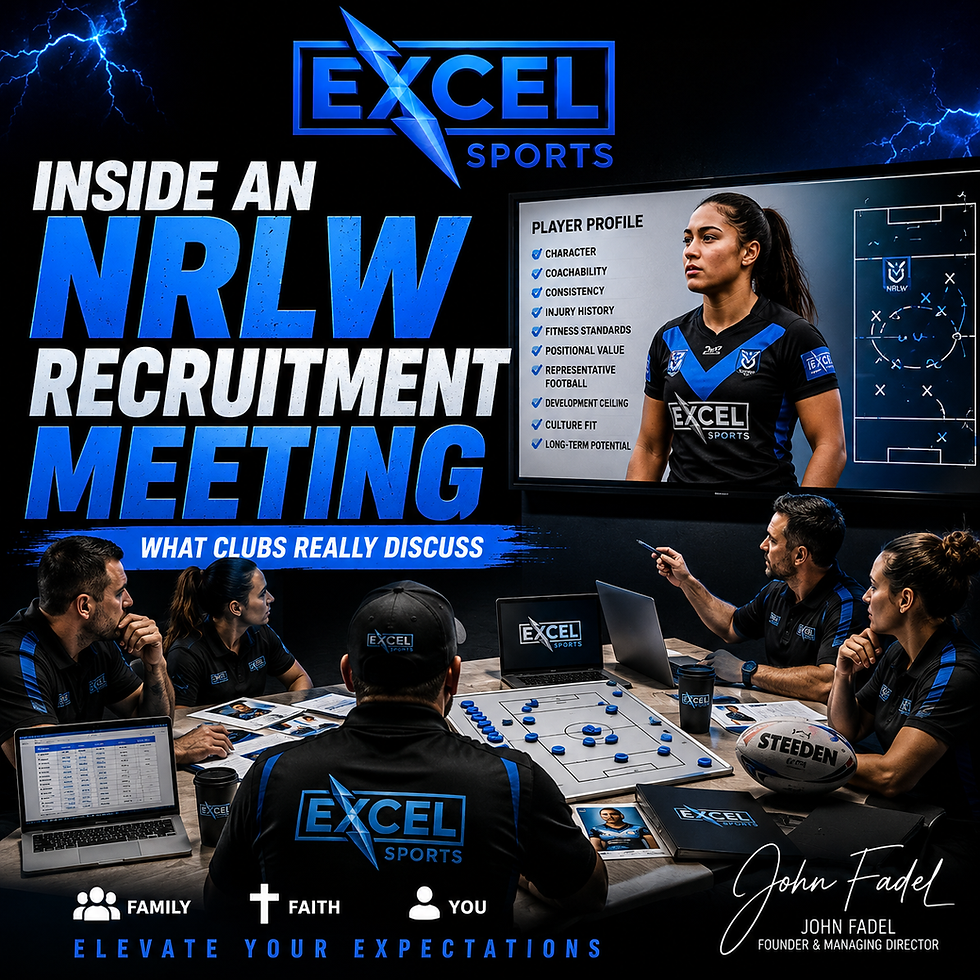
What Really Happens Inside an NRLW Recruitment Meeting

Introduction
Every player's dream is getting that phone call.
"Congratulations, you've been offered an NRLW contract."
But what actually happens before that phone rings?
Who makes the decision?
What are clubs really discussing behind closed doors?
Why does one player get selected while another misses out?
Is it statistics?
Representative honours?
Highlight videos?
Or is there far more happening inside an NRLW recruitment meeting than players and parents ever realise?
One of the questions I'm asked more than any other is:
"How did that player get selected when my daughter didn't?"
People compare statistics.
They compare representative teams.
They compare highlight reels.
They compare contracts.
On paper, they believe one player is clearly ahead of another.
Yet the recruitment decision goes the other way.
Why?
The answer is that recruitment is far more complex than most people think.
In my opinion, there are recruitment decisions every year that don't produce the long-term outcome clubs were hoping for.
Some development players never progress.
Some Top 24 signings struggle to establish themselves.
At the same time, other players who were overlooked go on to become outstanding NRLW footballers.
That's the reality of recruitment.
It isn't an exact science.
Representative football doesn't guarantee an NRLW contract.
I've seen Under-19 State of Origin players miss out.
I've seen Australian Schoolgirls representatives miss out.
Representative honours create opportunities.
They don't guarantee contracts.
Having spent more than a decade working in female rugby league pathways, player recruitment and contract negotiations, I've had the opportunity to see how recruitment really works.
Over the years, I've also developed my own approach to negotiations.
I wasn't taught how to negotiate an NRLW contract.
My background comes from business, where contract negotiations have been part of my career for many years.
The principles remain the same.
What outcome are we trying to achieve?
What creates value?
What are the best-case and worst-case scenarios before we even sit down at the table?
Every negotiation starts long before the meeting itself.
In this article, I'll take you inside an NRLW recruitment meeting and explain what clubs are really discussing, what influences recruitment decisions, where clubs and player agents sometimes see things differently, and why understanding the recruitment process can completely change the way players prepare for their future.
Who Actually Sits In An NRLW Recruitment Meeting?
Every club operates slightly differently, but in my experience, most NRLW recruitment meetings involve a similar group of decision-makers.
Almost every recruitment meeting will include the Head Coach and the Recruitment Manager.
Depending on the club and the player being discussed, there may also be input from the Pathways Manager, Assistant Coaches or the Football Manager.
If a player is returning from injury or has a significant medical history, medical staff may also contribute.
Salary cap or high-performance staff can become involved when required, particularly for more complex roster decisions, although they are not always present during every discussion.
No two clubs are identical.
However, one thing remains consistent.
Recruitment is rarely decided by one person.
The best decisions come from collaboration, discussion and planning.
The First Question Isn't "How Good Is She?"
This surprises many players and parents.
Most people believe the first question clubs ask is,
"How good is she?"
In my experience, that usually isn't where the discussion begins.
The first questions are far more strategic.
Do we need her?
Does she suit our system?
Does she fill a positional need?
Can she improve our squad?
Does she fit our culture?
Those five questions often shape the entire conversation before anyone starts talking about talent.
That might surprise people.
But recruitment isn't simply about finding the best footballer.
It's about finding the right footballer for that particular club at that particular time.
Do We Need Her?
Some people hear this question and think it's disrespectful.
It isn't.
It's simply the starting point.
Every club is trying to solve a football problem.
Perhaps they're looking for an edge back-rower.
Perhaps they need another middle forward.
Perhaps they're recruiting for depth while developing a player for another position over the next two seasons.
Sometimes clubs see qualities that aren't immediately obvious.
A player may currently play on an edge, but recruiters might believe she has the physical attributes to become an outstanding middle forward.
Or perhaps they see someone capable of transitioning into the centres.
Recruitment isn't always about where a player is today.
Often it's about where a player could be tomorrow.
Does She Suit Our System?
Every club plays differently.
Some teams play with speed through the middle.
Others rely on strong edge runners.
Some have dominant halves.
Others play through powerful middle forwards.
A player who excels in one system may not be the perfect fit for another.
Recruitment is about understanding how a player's strengths complement the way that particular club wants to play.
Does She Fill A Positional Need?
Sometimes a club rates a player highly but already has strength in that position.
Other times, a club identifies an opportunity to develop a player into a completely different role.
The question isn't simply,
"Can she play?"
It's,
"Where can she provide the greatest value to our squad?"
Can She Improve Our Team?
If a club has invited discussions about a player, they've already seen qualities they like.
The conversation then shifts from identifying talent to understanding how that player strengthens the squad.
Can she improve standards?
Can she increase competition for positions?
Can she make the team better over the next three or four seasons?
Recruitment is always about building the entire roster, not just signing individuals.
Does She Fit Our Culture?
In my opinion, this is one of the most important questions asked in any recruitment meeting.
Ironically, it's often the least discussed publicly.
Culture cannot be measured on a statistics sheet.
It isn't captured in a highlight video.
It isn't reflected in representative honours.
Instead, clubs are trying to understand the person.
What is her attitude like?
Will she embrace hard work?
Does she arrive early and leave late?
Is she coachable?
Will she support teammates?
Will she create unnecessary drama?
Does she take responsibility?
Does she genuinely want to improve?
Talent may get a player into the conversation.
Character is often what gets the deal done.
Throughout my career, I've found that when a player combines the right attitude with genuine talent, recruitment conversations become much easier.
Attitude isn't just another box to tick.
It's often the deciding factor.
What Clubs Actually Discuss During An NRLW Recruitment Meeting
This is where the recruitment meeting really begins.
Most players believe clubs spend the majority of the meeting discussing how talented someone is.
In my experience, that's only one small part of the conversation.
By the time a player's name reaches the recruitment table, the club has usually done its homework.
They've watched the games.
They've reviewed the footage.
They've spoken to people who know the player.
The real discussion is about whether that player is the right fit for the club.
Good recruiters prepare thoroughly.
They want to know the footballer.
More importantly, they want to know the person.
A club may speak with former coaches, representative staff, senior players, pathway coaches or others who have worked closely with that athlete.
They're trying to build a complete picture.
One thing I always remind clubs is that people grow.
A player should never be judged solely on who they were two or three years ago.
The question is always:
Who are they becoming?
Character
Character is one of the first topics discussed.
Is this someone people enjoy having around?
Do they take responsibility?
Can they be trusted?
Do they add value to the environment?
Character is difficult to teach.
That's why clubs place so much importance on it.
Coachability
Talent gets noticed.
Coachability keeps players in the system.
Can this player accept feedback?
Do they genuinely want to improve?
Do they ask questions?
Can they adapt when challenged?
The players who continue developing are usually the players who embrace coaching.
Consistency
One outstanding performance doesn't earn a long-term contract.
Recruiters want consistency.
Can this player deliver every week?
Can they maintain standards throughout an entire season?
Consistency builds trust.
Injury History
Availability matters.
Recruiters consider previous injuries, recovery history and long-term durability.
This isn't about judging players.
It's about understanding risk and planning for the future.
H3: Development Ceiling
One of the biggest questions recruiters ask is:
How much better can this player become?
Some players are already close to their ceiling.
Others have enormous upside.
Recruitment is often about future potential as much as current ability.
Work Ethic
This speaks for itself.
Who arrives early?
Who stays behind?
Who asks for extra work?
Who genuinely wants to improve?
Great work ethic is noticed long before contract discussions begin.
Fitness Standards
Fitness creates opportunity.
Recruiters want to know whether players can consistently meet the physical demands of elite rugby league.
Talent without fitness rarely succeeds for long.
Positional Value
Can the player perform multiple roles?
Do they provide flexibility?
Can they strengthen areas where the club lacks depth?
Versatility often increases a player's value.
Representative Football
Representative honours certainly attract attention.
State of Origin.
International football.
City versus Country.
Australian Schoolgirls.
These achievements demonstrate that selectors have recognised a player's ability.
However, representative football alone does not guarantee an NRLW contract.
It creates exposure.
The recruitment meeting still decides whether the player fits the club.
Video Analysis
Has the player been exposed to video review?
Do they understand how to analyse their own performance?
The best athletes don't simply watch highlights.
They study mistakes.
They review decisions.
They identify areas for improvement before coaches even ask.
That level of ownership stands out.
Pathway Progression
Recruiters want to understand where the player currently sits in their development.
Are they ready now?
Will they be ready in twelve months?
Or are they part of a longer-term pathway plan?
Recruitment is rarely just about the next season.
Off-Field Reputation
Football ability is only one part of recruitment.
Professionalism matters.
Communication matters.
Behaviour matters.
The way a player represents themselves away from the field also contributes to their reputation.
Family Support
Strong support networks help players navigate the pressures of elite sport.
Recruiters understand that family, mentors and positive influences can all contribute to long-term success.
Long-Term Projection
Perhaps the biggest question of all.
Where could this player be in three years?
The best recruiters don't simply recruit today's player.
They recruit tomorrow's player.
What Stops A Player Being Signed?
Many outstanding footballers never receive an offer.
Not because they aren't talented.
But because recruitment is influenced by many different factors.
Timing.
Salary cap restrictions.
The position is already filled.
The player doesn't suit the team's style of football.
Physical readiness.
Long-term roster planning.
Another player may simply be a better fit.
Sometimes attitude raises concerns.
Sometimes another player has greater long-term potential.
Recruitment is about far more than ability alone.
How Elite Recruitment Teams Think
One of the biggest differences I see between clubs is how far ahead they plan.
Some clubs focus almost entirely on the next twelve months.
Others plan two years ahead.
The strongest recruitment teams are often thinking three years into the future.
While everyone else is focused on today's roster, they're already identifying tomorrow's spine.
They're securing key positions early.
They're planning succession.
They're investing in players before everyone else recognises their value.
That doesn't guarantee success.
But it gives those clubs a significant advantage.
In my experience, the best recruitment teams don't simply recruit players.
They build a football program.
They understand that today's fifteen-year-old could become tomorrow's Origin player.
They don't recruit for next weekend.
They recruit for the next five years.

Final Words From John Fadel
The biggest mistake I see every year is players believing recruitment starts after they've had a great season.
The reality is, recruitment starts long before the season begins.
If we're sitting here in July, many clubs are already planning for the following season.
The better recruitment teams are planning two years ahead.
The elite recruitment teams are already thinking three years into the future.
They're identifying players for 2027, 2028 and even 2029.
They're looking at your age.
Your development.
Your attitude.
Your work ethic.
Your long-term potential.
They want to know whether you've been part of an environment that has helped you improve, because they understand that development never stops.
Recruitment isn't just a gamble for the player.
It's a gamble for the club as well.
Every contract is an investment.
Every signing carries risk.
That's why clubs look far deeper than statistics or highlight videos.
Every training session.
Every conversation.
Every decision you make.
Every interaction with teammates and coaches.
Every one of those moments is building your reputation.
Don't prepare for the phone call.
Prepare for the recruitment meeting that's happening behind closed doors.
Become the player every club wants to discuss.
At EXCEL Sports, people often ask me whether success comes down to connections.
The answer is yes—but probably not in the way most people think.
Relationships matter.
Trust matters.
But our greatest strength isn't simply who we know.
It's how we help players prepare before those conversations ever take place.
Our development.
Our mentoring.
Our standards.
Our commitment to helping players become the best version of themselves.
I've always believed one simple principle.
Don't wait to be picked.
Become impossible to ignore.
That's what real development looks like.
That's what creates long-term careers.
Excel with us.
Family • Faith • You.
To learn more about EXCEL Sports Management or to get in touch, click here.
External Home pages:


Comments